

Court-Appointed Qualified Legal Representatives (QLRs): Practice & Procedure
By Dr Paul Chu Chiy
Barrister, Solicitor-Advocate, FCIArb, FCILEx
Chair, Association of Qualified Legal Representatives (AQLR)
Foreword by Rt Hon Sir Robert Buckland KBE KC MP
Former Lord Chancellor and Secretary of State for Justice
Read more
Court-Appointed Qualified Legal Representatives (QLRs): Practice & Procedure is the first comprehensive practitioner handbook devoted exclusively to the court-appointed QLR scheme in England and Wales.
Introduced to prevent the injustice and retraumatisation associated with in-person cross-examination in cases involving allegations of abuse, the QLR scheme now operates as a routine and essential feature of family and civil proceedings. Despite its importance, the statutory purpose, professional boundaries and practical operation of the role have remained widely misunderstood and inconsistently applied.
This authoritative 357-page handbook provides a clear, court-facing account of QLR practice as it operates in reality. Written by an experienced practitioner and Chair of the Association of Qualified Legal Representatives, it explains the statutory framework governing appointment, scope and remuneration, and offers detailed guidance on preparation, advocacy, vulnerable witnesses, hearings, ethics and professional risk.
Designed as a working manual rather than an academic text, the book addresses the recurring operational challenges faced by QLRs and courts alike, including urgent appointments, defective bundles, scope creep, judicial control and evidentially complex hearings conducted under significant pressure. Practical checklists, templates and worked examples support consistent, defensible practice in live appointments.
This publication is an essential resource for court-appointed QLRs, judges, court staff and practitioners working within the statutory scheme.
All net proceeds support the work of the Association of Qualified Legal Representatives (AQLR)
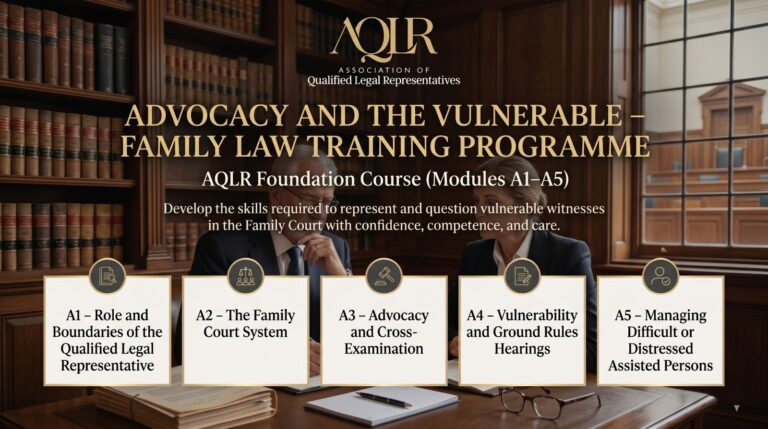
Advocacy and the Vulnerable – Family Law Training Programme
AQLR Foundation Course (Modules A1–A5)
Develop the skills required to represent and question vulnerable witnesses in the Family Court with confidence, competence, and care.
Why This Course Matters
The Family Court has undergone a significant cultural and procedural shift in how vulnerable parties and witnesses are treated. It is now widely recognised that those giving evidence must be protected and enabled to participate fully, with proper regard to their individual vulnerabilities.
Read more
Advocacy and the Vulnerable – Family Law Training Programme
AQLR Foundation Course (Modules A1–A5)
Develop the skills required to represent and question vulnerable witnesses in the Family Court with confidence, competence, and care.
Why This Course Matters
The Family Court has undergone a significant cultural and procedural shift in how vulnerable parties and witnesses are treated. It is now widely recognised that those giving evidence must be protected and enabled to participate fully, with proper regard to their individual vulnerabilities.
This reform was driven in large part by the work of Sir James Munby during his tenure as President of the Family Division, culminating in the introduction of FPR Part 3A and Practice Direction 3AA. These provisions place clear obligations on advocates to adapt their approach when dealing with vulnerable individuals.
Evidence from vulnerable witnesses is often shaped by fear, misunderstanding or suggestibility. Traditional advocacy techniques are no longer sufficient. It cannot be lost on those practising in family law that the time has come for properly integrated, specialist training in this area.
About the Programme
The AQLR Foundation Course is a structured training programme designed to equip family law practitioners with the knowledge, ethical framework, and practical advocacy skills required to operate effectively in modern family proceedings.
Developed in response to increasing demand for specialist advocacy training, the programme builds upon the principles underpinning the widely recognised “Advocacy and the Vulnerable” framework and adapts them specifically for the Family Bar and those operating within family proceedings.
The programme comprises five core modules:
- A1 – Role and Boundaries of the Qualified Legal Representative
- A2 – The Family Court System
- A3 – Advocacy and Cross-Examination
- A4 – Vulnerability and Ground Rules Hearings
- A5 – Managing Difficult or Distressed Assisted Persons
Core Principles and Learning Approach
The course is underpinned by the 20 Principles of Questioning Vulnerable Witnesses, which form the foundation of modern advocacy in this area. Delegates will be expected to understand and apply the key principles governing both the approach to, and questioning of, vulnerable individuals within the justice system, irrespective of the nature of the allegation or the jurisdiction in which they practise.
Participants will learn to adapt their advocacy style to ensure that evidence is obtained fairly, reliably, and without causing unnecessary distress or confusion.
What You Will Learn
Participants will:
- Understand the statutory framework governing vulnerable witnesses, including FPR Part 3A and PD3AA
- Develop trauma-informed advocacy techniques
- Conduct effective and appropriate cross-examination of vulnerable adults and children
- Navigate Ground Rules Hearings and special measures
- Apply ethical judgment and maintain professional boundaries
- Manage challenging or distressed individuals while preserving fairness in proceedings
Course Structure, Duration and Assessment
The programme is designed to ensure both theoretical understanding and practical competence.
Duration
Each module comprises:
- 6–8 hours of guided learning (contact time)
- 3 hours of self-directed study
The full Foundation Programme (Modules A1–A5) is typically delivered over 5 training days, which may be scheduled consecutively or in stages.
Pre-course preparation
Participants will complete directed pre-reading, including statutory materials and guidance, together with a short preparatory assessment to ensure familiarity with the framework prior to attendance.
During the course
Learning is delivered through:
- Interactive lectures
- Practical simulations and role-play
- Case-based exercises
- Reflective discussion
End of course assessment
Participants will be assessed through a combination of:
- Knowledge-based testing
- Observed practical exercises (including advocacy simulations)
- Reflective written work
Successful completion requires demonstration of both knowledge and applied skill.
Course Delivery
- Delivered on a flexible, on-demand basis
- Scheduled around the availability of the first confirmed attendee
- Available in-person or virtually
- Delivered by experienced Qualified Legal Representatives with decades of family law experience
Fees
Course fees vary depending on the number of attendees. Please contact us for a tailored quotation.
Who Should Attend
This course is suitable for:
- Barristers and solicitors practising in family law
- Qualified Legal Representatives (QLRs)
- Legal practitioners seeking accreditation in vulnerable witness advocacy
- Those undertaking or expanding work involving vulnerable parties in the Family Court
Accreditation and Progression
- AQLR Foundation Certificate (Modules A1–A5)
- Eligibility for Associate Membership
- Progression to Specialist Accreditation Tracks
Why This Course
- Designed specifically for family proceedings
- Aligned with judicial expectations and procedural rules
- Focused on practical advocacy skills
- Combines preparation, structured training, and formal assessment
- Delivered flexibly to suit professional schedules
- Addresses a critical and growing need within the Family Justice system
Register Your Interest
To register your interest or request further information, please click above.